Tacos de Canasta Aren't Simple. They're a Precision-Engineered Thermal Delivery System.
Tacos de canasta aren't simple. They're a precision-engineered thermal delivery system built to feed a city of millions. Here's how they actually work.
Joshua
12/6/20254 min read
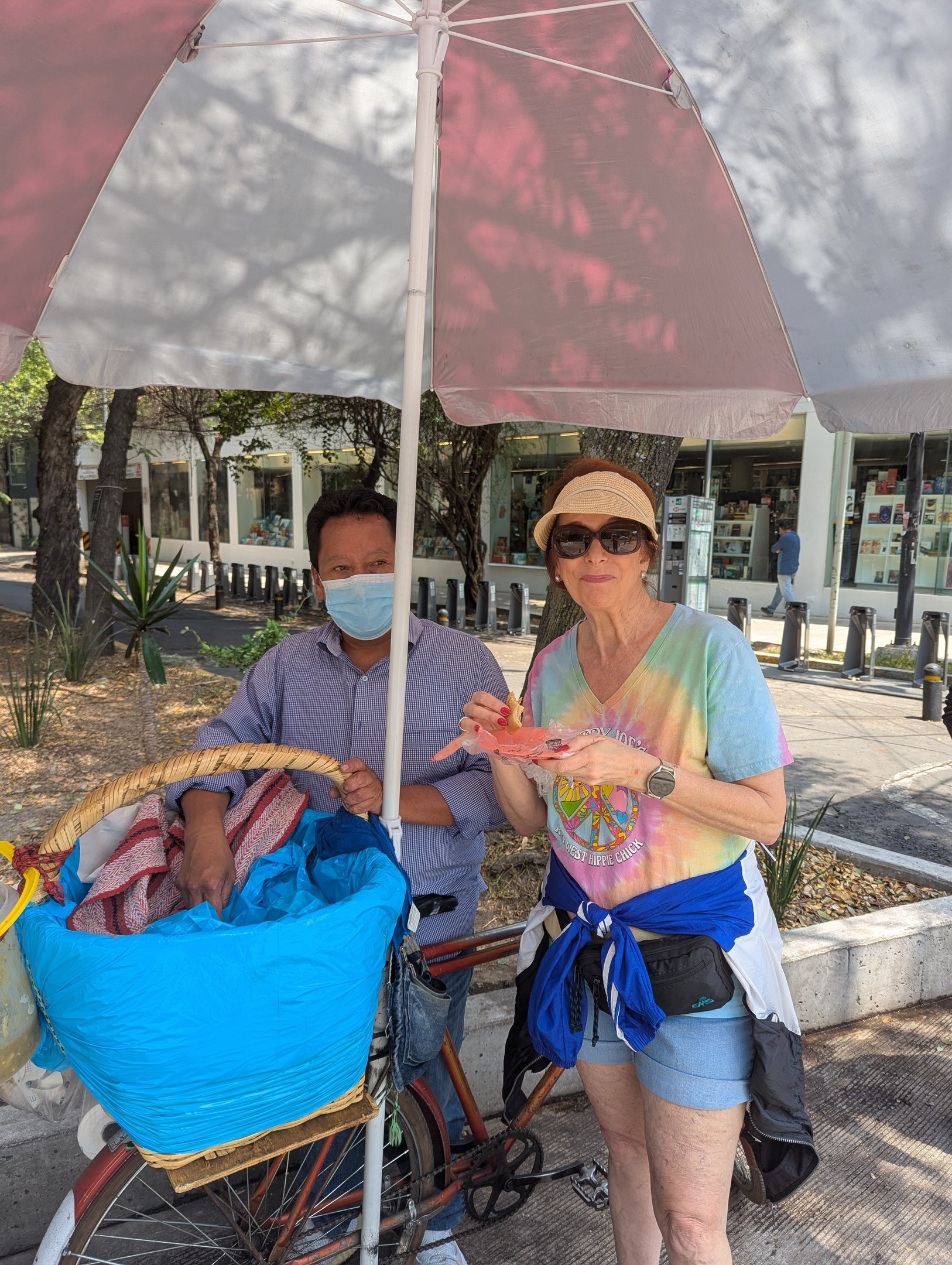
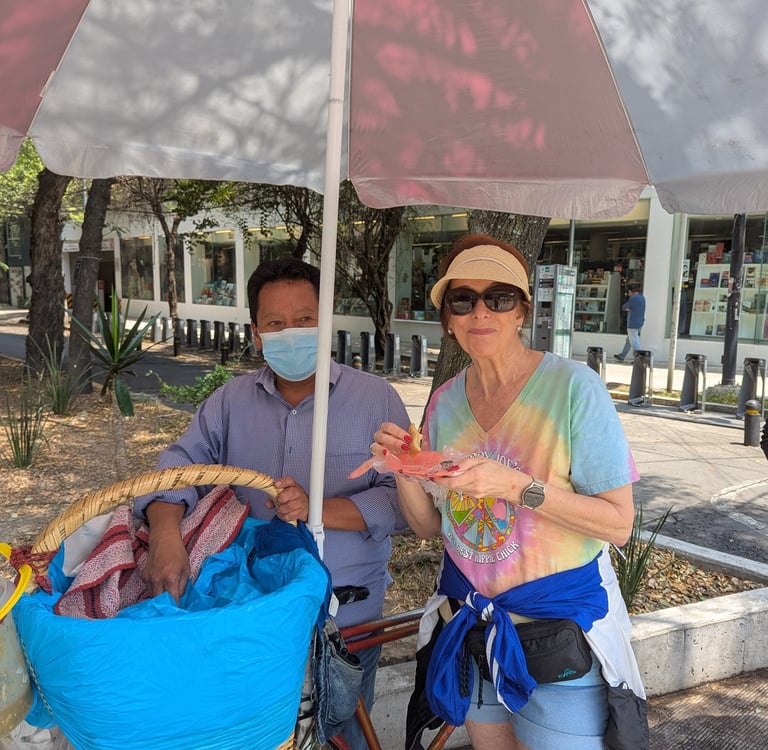
At some point on your first day in Mexico City, you will see a man on a bicycle with an enormous basket strapped to the back. Inside that basket, wrapped in plastic and cloth and butcher paper, are hundreds of tacos.
They were made hours ago. They have been sitting in that basket, sealed, steaming, absorbing heat since before you woke up. And somehow, when you buy one, it is soft and warm and exactly right.
This is not an accident. This is engineering.
What Street Food Actually Is in Mexico City
In most cities, street food is a treat. A novelty. Maybe a late-night convenience option for people who don't want to cook.
In Mexico City, it's different. Due to the sheer overwhelming size of the place — 22 million people spread across a metropolis with commute times that can run two hours each way — and the very small size of most domestic kitchens, the street is literally where the city eats. It functions as the city's primary dining room. The fueling station for the daily economy.
"Street food in Mexico City isn't cheap eats or novelty. It is primary food infrastructure — as essential to how the city functions as the subway system."
When you understand that, the taco de canasta stops being a street snack and starts being exactly what it is: the most efficient portable calorie delivery system ever designed for urban workers.
How the Basket System Works
The engineering starts before sunrise.
A basket taco vendor wakes up in the early hours of the morning and begins making tacos — not one or two at a time, but hundreds. Sometimes thousands. The fillings are always simple: refried beans, chicharrón, potato with chorizo, perhaps rajas. Nothing that requires complicated preparation or last-minute assembly.
The tacos are stacked into deep baskets lined with layers of plastic, cloth, and butcher paper. Then — and this is the critical step — they are doused in boiling hot oil or hot salsa and immediately sealed shut.
Inside the sealed basket, the tacos don't just stay warm. They continue cooking. The basket creates a self-contained thermal environment — a steam chamber — that keeps the tacos at temperature and actively softens them further as the vendor travels the city.
"The sealed basket isn't just insulation. It's an active cooking environment. The tacos arrive softer than when they were made."
Sudados is the word for them. Sweaty tacos. And that texture is not a flaw to be apologized for — it is the entire point of the design. A sudado taco never dries out, never toughens, never gets cold. A delivery rider can grab three of them, eat standing up in under two minutes, and have reliable fuel for the next four hours of a shift.
Memory-Driven Cuisine
Here is the thing about tacos de canasta that separates them from every other taco style: you don't buy one for a culinary surprise.
The sources we've been studying call this memory-driven cuisine, and the phrase is exactly right. You buy a basket taco because you know precisely what it will taste like. You know the texture. You know the specific fillings from this specific vendor. You know it costs a few pesos. You know it will work.
There is a category of food — in every culture, in every city — that exists not to impress you but to be reliable. To be there when you need it, tasting exactly like it always tastes, costing exactly what it always costs. In New York it's a bodega coffee. In Tokyo it's a convenience store onigiri. In Mexico City it's a basket taco from the vendor who has been on your corner for twenty years.
That reliability is not a lesser form of food culture. It is the backbone of it.
The Urban Anchor Point
There's a broader concept at work here that connects the basket taco to the entire logic of how Mexico City functions.
This is a city that is, literally, sinking. Built on a dried lakebed of soft clay, compressed under the weight of 22 million people and a century of over-extracted groundwater, Mexico City sinks a few centimeters every year. In some neighborhoods, the total subsidence over the last century is measured in meters.
And yet the city runs. 22 million people navigate it daily — its overlapping metro lines, its chaotic streets, its labyrinthine neighborhoods that evolved without a grid. How do people organize their movement through a place this large and this complex?
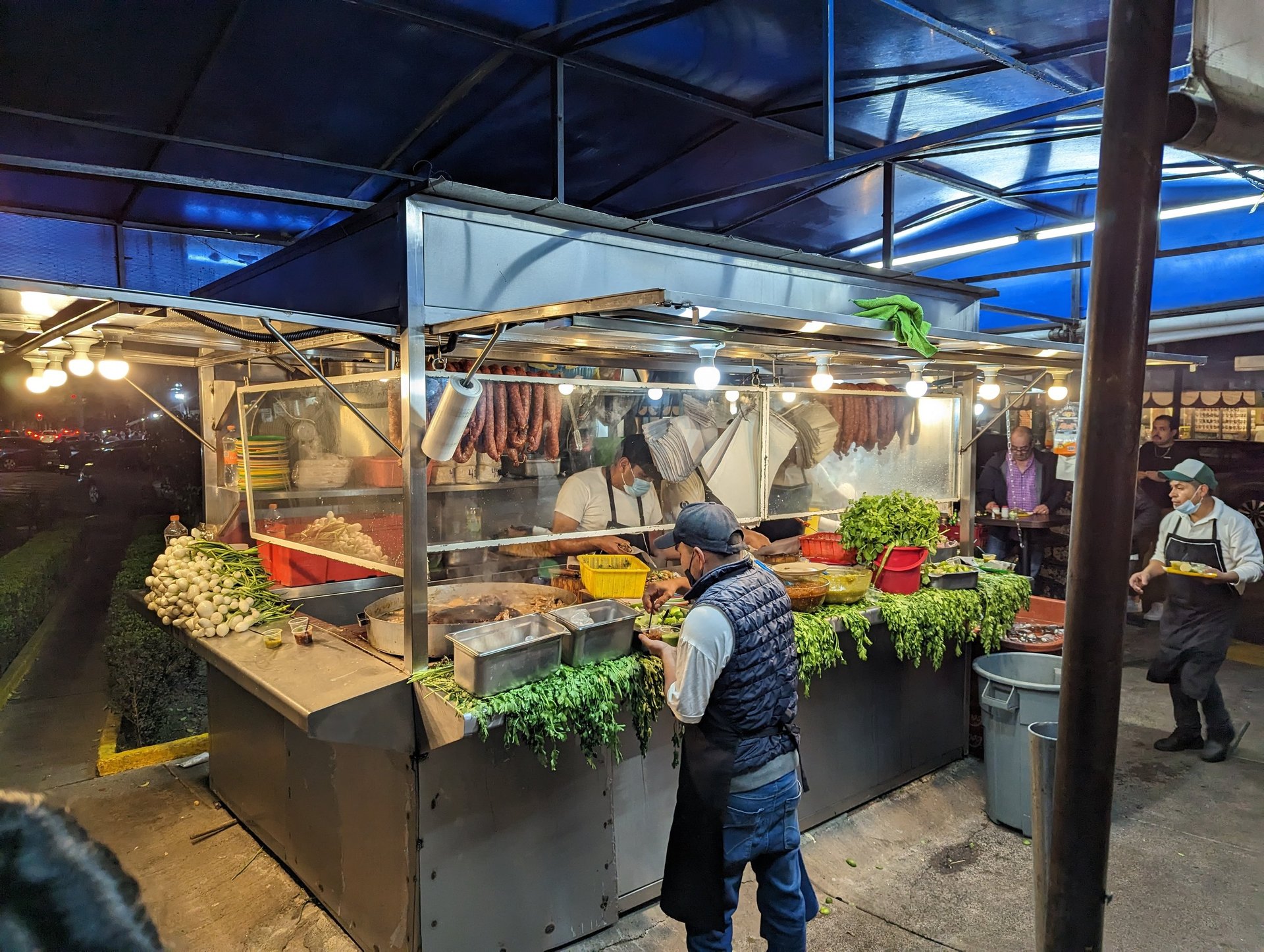
Partly through food. The specific basket taco vendor on the specific corner at the specific morning hour is an anchor point. It dictates a route. It creates a schedule. The al pastor stand you hit on the way home provides another anchor point. The weekend barbacoa family that sets up in Condesa provides another. The food infrastructure of the city — the reliable, predictable, always-in-their-spot vendors — functions as a navigation system.
"The taco stand is the user interface of the city. It's the critical interface between the individual citizen and the massive urban sprawl."
Try a Basket Taco on Your Tour
On our Narvarte and Centro Histórico tours, we stop at traditional basket taco vendors — the real ones, not the tourist-facing versions — and our guides explain exactly what you're eating and why this style exists. You'll understand the steam. You'll understand the simplicity. You'll understand why this is a feature, not a limitation.
Book your Mexico City taco tour at provechotacotours.com.
Join us for authentic taco experiences.
Discover
Hola@provechotacotours.com
© 2025. All rights reserved.