Mexico City's Street Food Isn't a Dining Option. It's Infrastructure.
Mexico City's street food isn't a dining option. It's the primary system that feeds 22 million people. Here's why that distinction changes everything about how you eat here.
Joshua
10/1/20255 min read
In most of the world, when you talk about street food, you're talking about a category of dining. A price point. An aesthetic. Something you choose over a sit-down restaurant for reasons of speed, cost, or atmosphere.
In Mexico City, that framing completely fails.
Mexico City's street food is not a category of dining. It is the primary mechanism by which 22 million people feed themselves every single day. It is infrastructure — as load-bearing for daily urban life as the metro system, the water supply, or the power grid.
Understanding this changes everything about how you experience the food here.
The City the Food Was Built For
To understand why Mexico City's street food system works the way it does, you have to understand the city it was built to serve.
Tenochtitlan, the original city on this site, was founded in 1325 on an island in the middle of Lake Texcoco. At its peak, it held somewhere between 200,000 and 300,000 people — one of the largest cities on Earth at the time, comparable in scale to Paris or Constantinople.
Being an island city meant you could not sprawl. Every person in that city needed to be fed densely and efficiently. The food infrastructure that evolved — portable, fast, nutritionally complete, built around the nixtamalized tortilla as a structural platform — was not cultural accident. It was an engineering response to a geographic constraint.
The Spanish conquest came. The lake was drained. A European colonial city was built on the dried clay lakebed, which has been slowly sinking ever since under the weight of the buildings above it. But the density never left. The walking city never became a driving city. And the food infrastructure built for 300,000 people on an island evolved — layer by layer, immigrant wave by immigrant wave — into the system that now feeds 22 million people across a megacity.
"That original constraint — the intense density of an island city — never really went away. It created a walking city DNA from the very start. And dense walking cities produce very specific food cultures."
What Makes CDMX Street Food Different From Every Other City
Here's the specific set of pressures that shape Mexico City's food infrastructure in ways that don't exist in the same combination anywhere else:
Scale. 22 million people in the metropolitan area. The concentration of demand is staggering.
Commute times. Mexico City has some of the worst traffic in the world. Two-hour commutes each way are common. Many workers cannot go home for lunch. They need to eat wherever they are, whatever time they have.
Kitchen size. Many apartments and homes in the city have extremely small kitchens. Cooking a full meal at home three times a day is not realistic for a large portion of the population.
Price. Street food in Mexico City is cheap relative to restaurant dining — by design, because it has to be. It serves the entire economic spectrum, from day laborers to tech workers.
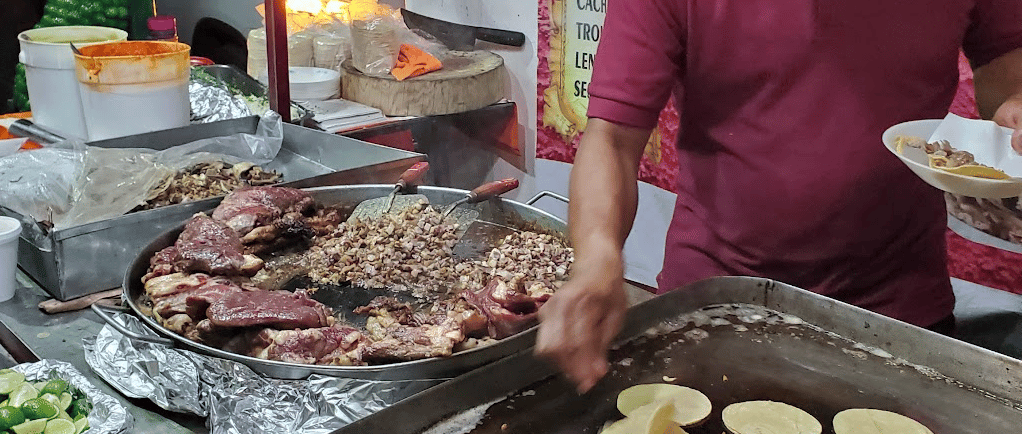
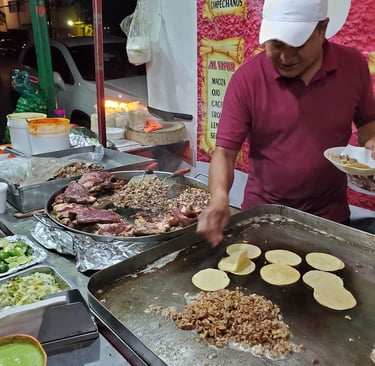
Put those pressures together and you get a street food system that isn't optional. It's the solution the city arrived at because it had to. The basket taco steamed in a sealed vessel since 4am. The al pastor trompo that runs from noon until midnight. The weekend barbacoa stand that sells out in two hours. Each one is a specific response to a specific gap in how people need to eat.
The Taco as Navigation System
There's a concept that comes up repeatedly when you study Mexico City's food culture carefully, and it's the one that reframes everything:
The street food vendors are anchor points for daily navigation.
This city is chaotic and enormous. It is literally sinking into the earth. Its streets evolved without a master grid. Its 22 million residents need some mechanism for organizing their daily movement through the sprawl.
The food infrastructure provides that mechanism. The specific basket taco vendor who has been on the same corner for twenty years dictates a morning route. The al pastor stand near your office dictates an afternoon detour. The barbacoa family in Condesa structures a Sunday morning. The seafood stand that appears in Roma Norte on weekend afternoons creates a social appointment.
"The taco stand is the user interface of the city. The food infrastructure is the literal blueprint for how people interact with urban space — not just where they eat, but where they go, when they go there, and who they meet."
This isn't poetic metaphor. It is an accurate description of how people actually navigate. When researchers study movement patterns in dense urban environments, food — specifically, reliable food at predictable locations and times — consistently emerges as a primary organizing principle.
In Mexico City, that organizing principle is visible everywhere. The vendors who have been on the same corner for forty years aren't just feeding people. They are nodes in the city's living infrastructure.
The Evolution Continues
What makes this system remarkable is that it hasn't stopped evolving.
The Lebanese immigration wave of the early 20th century introduced the vertical spit, which became al pastor. Right now, South American immigration is introducing cassava bread — pan de yuca — into neighborhoods like Condesa, where it's being sold alongside traditional street tacos. The city is absorbing a new starch ecosystem in real time.
The vegan taco movement in Mexico City isn't about replacing meat with processed substitutes. It's about applying taco logic — structural base, textural element, fat to carry flavor, acid to cut it — to vegetables. Mushrooms, chelites, hibiscus flowers cooked with enough oil and hit with the right complex salsa. The format proved it could absorb anything. The city proved it will absorb everything.
At the other end of the spectrum, the picanha taco — sirloin cap from Brazil, grilled over coals with minimal intervention — arrived recently and became its own specific genre. Maximum ingredient clarity. No sauce to hide behind. The format absorbed a Brazilian cut, Mexican technique, and produced something that reads as unmistakably CDMX.
What This Means When You Visit
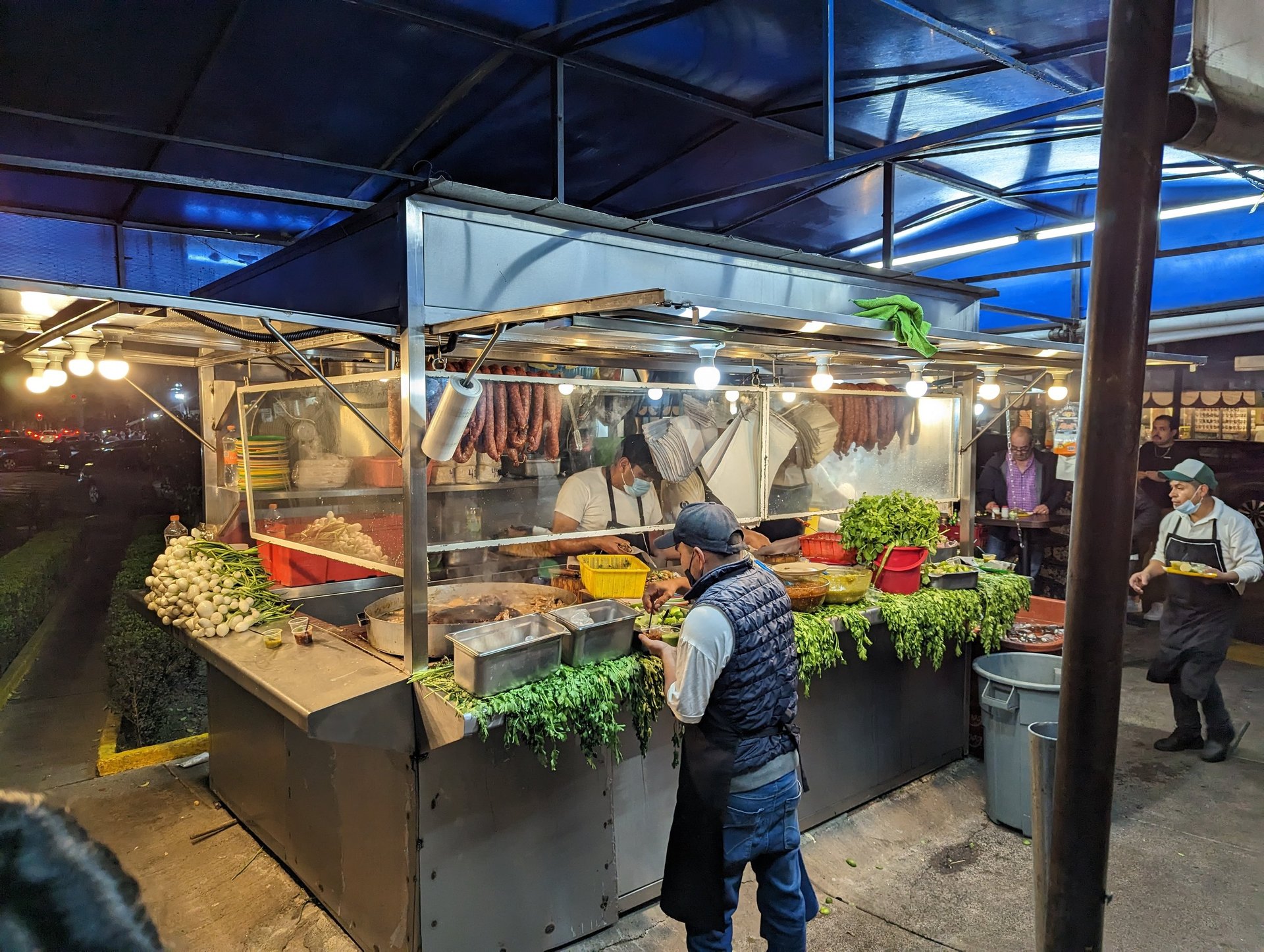
When you walk through Mexico City and see a taco stand, you are not looking at a cheap lunch option. You are looking at a node in the operational infrastructure of the largest city in North America.
The vendor has probably been there for years, possibly decades. They are there at a specific time because that is when the demand is there. The price has not moved much because it cannot. The filling is what it is because the customers have come to depend on it being exactly that.
To eat well in this city is to participate in that system — not as a tourist consuming an attraction, but as a person letting the city's logic guide you. You don't eat at the famous spot because it's famous. You eat at the vendor whose corner you pass every day, whose basket taco you know by texture before you open it, whose pineapple-topped trompo you time your walk past at 7pm specifically because it's at peak rotation.
That is what Mexico City street food culture actually is. Not a scene. A system.
Come Navigate the City with Us
Provecho Taco Tours runs small-group tours through Roma, Condesa, Narvarte, and Centro Histórico — each one designed around how the neighborhood actually feeds people, not around what looks good in photos. Our guides grew up in this city. They know the infrastructure the way locals know infrastructure: not as a concept, but as a daily practice.
Book your tour at provechotacotours.com. Come hungry. Come curious. The city will do the rest.
Join us for authentic taco experiences.
Discover
Hola@provechotacotours.com
© 2025. All rights reserved.